

|
Geodesic Dome
 developed a geodesic dome for Carl Zeiss in Jena Germany, he may be considered as the "inventor" of the geodesic dome. developed a geodesic dome for Carl Zeiss in Jena Germany, he may be considered as the "inventor" of the geodesic dome.
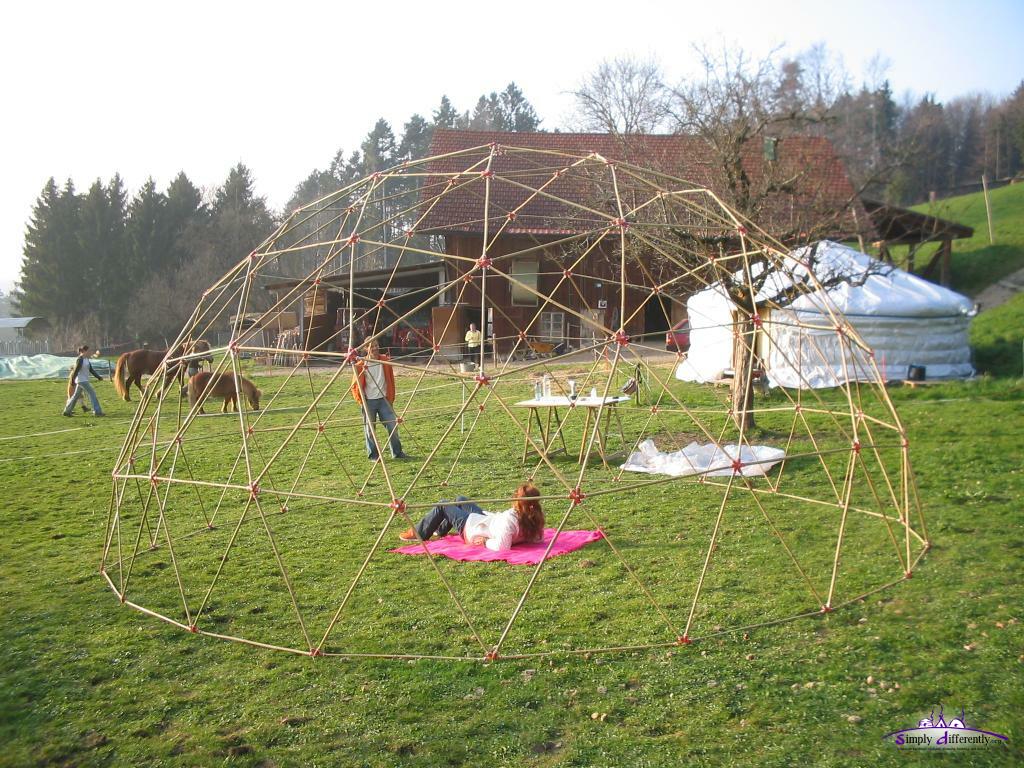
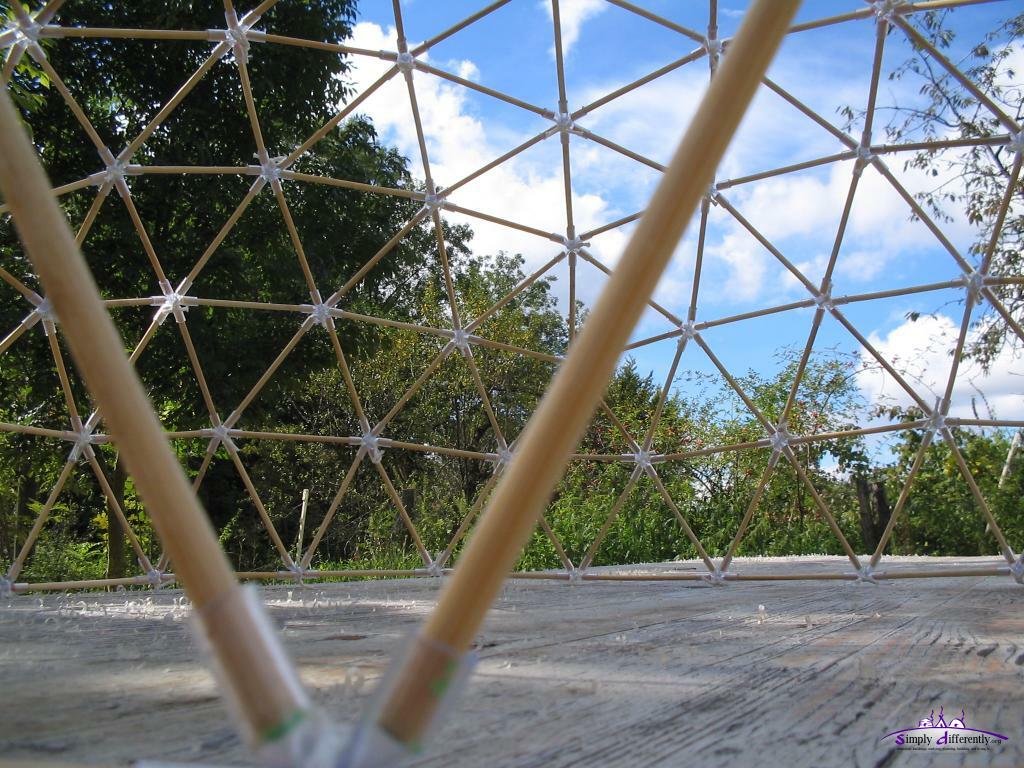
R. Buckminster Fuller Some hesitation I have to consider this structure because it looks challenging, on the first sight it's beautiful, yet, the lengths of the struts need to be exact, and you have a lot of connectors, and seams therefore where it can leak rain, so insulation around those connectors is important. My Geodesic Dome Notes, Diary & StudiesIn my notes I solved some of the calculation challenges, and are still checking which cover technique to use for the dome:
How To Manuals
Pro & ContraMy first reaction on the geodesic dome was of excitement to see such a construction form a half-sphere, though the smaller sub-division versions (like 2V) looked too edgy for my taste as I am more interested in round, smooth and circular forms. I realized, as mentioned above in the intro already, the many struts create many junctions and seams, and talking with geodesic enthusiasts increased my enthusiams but also increased my skepticism about the form, it remains a challenging structure to be built and extended to a living space.
I've got a copy of "Shelter", written by Lloyd Khan The difficulty to build a circular or spherical form should not be mistaken with the geodesic dome challenges altogether: Circular, spherical, or dome-like forms require more planning, and tend to create more waste; but this is a result of a "rectangular" thinking and producing with such mindset the parts, entire nature does not create such rectangular forms, only humans do. Therefore it requires also more consideration, and a change of mindset in order to think differently to economically build a spherical habitat, see also the other domes approaches:
Lloyd quickly replied to my query that majority of his arguments in Domes / Rectangles LinksMathematics
Commercial Suppliers
PatentsA couple of patents relating to geodesic dome I found via Google Patents, sorted by published year:
Buckminster Fuller"Geodesic Dome" is a term which is closely tied also to "Buckminster Fuller", an inventor who popularized this approach, among many things he focused his work to make the world a better place for everyone:
I personally wasn't able to really connect with Fuller's original work, e.g. Synergetics makes no sense to me, and consider one of most unreadable books I ever encountered. Other people could make some sense out of it and got inspired to follow up:
Communities
References
.:.
|




| Home | · | About | · |  Tipi | · |  Yurt | · |  Dome | · | Features | · | Gallery |



Creative Commons (CC) BY-SA-NC 2005-2017, developed, designed and written by René K. Müller
Graphics & illustrations made with Inkscape, Tgif, Gimp, PovRay, GD.pm
Web-Site powered by FreeBSD & Debian/Linux - 100% Open Source